

IMAGE DETAILS

COLNAGHI
Michaelina Wautier (Mons 1604-circa 1689 Brussels)
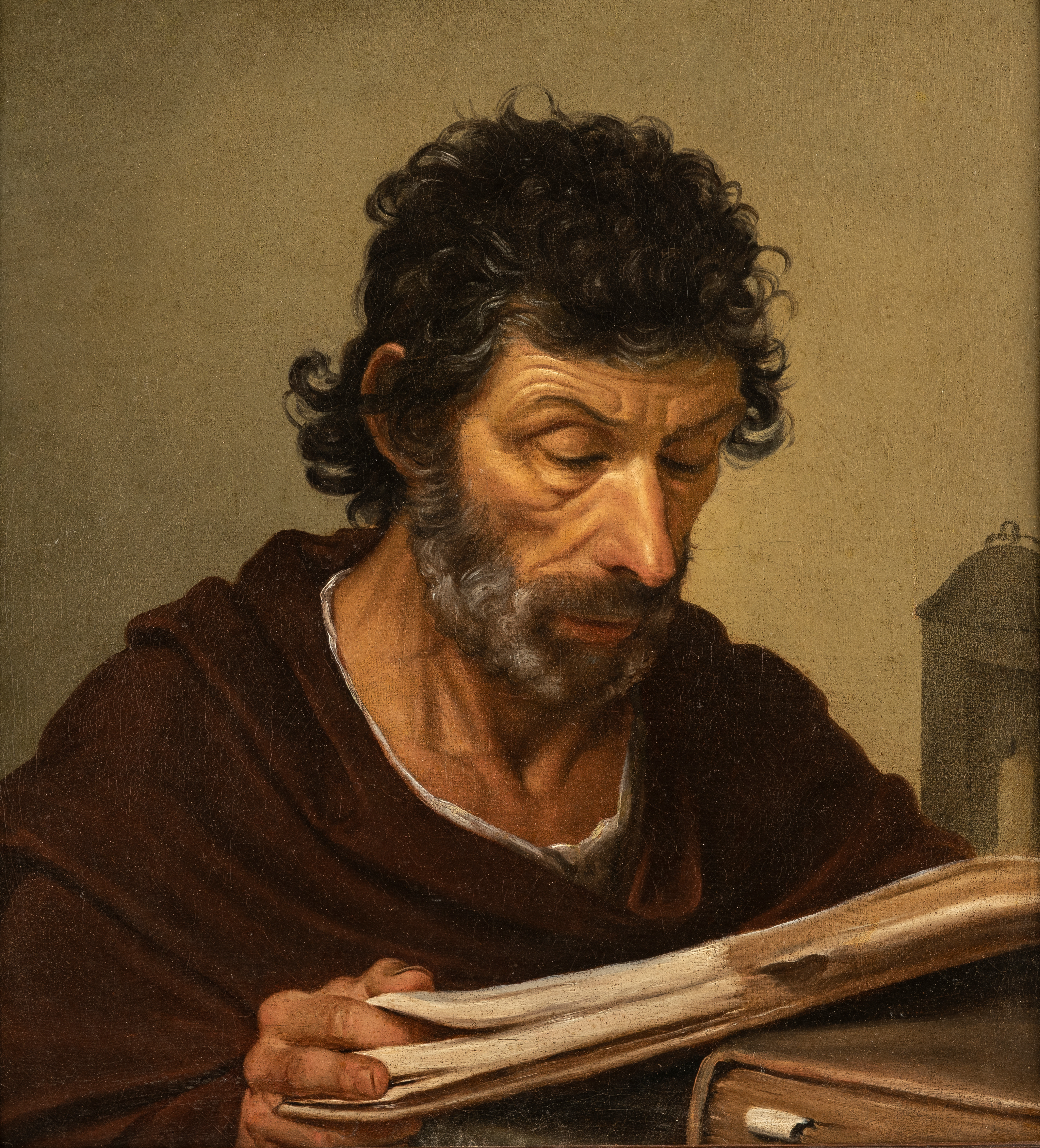
Diogenes reading, circa 1650
Oil on canvas
48.5 x 45 cm
Remains of a signature (?), along the edge of the cover of the closed book: [...] W [...] fecit
Inscribed lower centre, below the bookmark of the open book: diogine
Inscribed on the reverse: A[l]lievo di de la Tour / Michelin (Te[s?]to[lin?])
Provenance: private collection, Rome, before 2005; sale, Christie’s, Rome, 13 December 2005, lot 542 (as Follower of Le Nain Brothers, ‘Apostolo che legge’); sale, Dorotheum, Vienna, 21 October 2014, lot 349 (as French Caravaggist, Late 17th/Early 18th Century, ‘A man reading, Diogenes’); sale, Hampel, Munich, 22 September 2017, lot 802 (as Italian Caravaggist, 17th Century); sale, Nagel, Stuttgart, 18 March 2020, lot 543 (as Francesco Fracanzano (Kreis)); sale, Nagel, Stuttgart, 10 December 2020, lot 2057 (as Neapolitan School, 18th Century); where acquired by the present owner
Literature: Jahel Sanzsalazar, ‘An Honest Man: An Unknown Diogenes by Michaelina Wautier’, in Art & Deal, July-August 2024, pp. 14-23
Michaelina Wautier ranks among the most original and accomplished painters active in the Netherlands during the seventeenth century. Working across portraiture, religious subjects, and history painting, she produced works of notable ambition and scale. Despite evidence of contemporary recognition, her oeuvre fell into obscurity for centuries, in large part due to the circumstances of her gender and the fragmentary survival of documentary sources.
Nothing specific is known about Wautier’s formal training. Archival documents indicate that she was born and baptised in Mons in 1604 and, as an unmarried woman, likely remained there to care for her parents until at least her mother’s death in 1638. She was active as a painter in Brussels from around 1640 onwards, an opportunity likely facilitated by her younger brother, Charles, who was living and working in the city at that time. In the absence of contemporary documentary sources, Wautier’s works themselves provide the clearest insight into her artistic
formation. While she may have received some instruction from her brother, her paintings reveal an eclectic visual education, drawing on sixteenth- and seventeenthcentury Italian art as well as the work of Michael Sweerts, who established a drawing academy in Brussels in 1656 following his return from Rome. By this date, Wautier must already have been firmly established as one of Brussels’ leading painters.
The subject of this nearly square canvas is the philosopher Diogenes, shown halflength, seated against a subdued background and absorbed in reading. A lantern, traditionally associated with Diogenes’ search for an honest man, appears here discreetly and unlit behind the figure, rather than in the more familiar depictions in which it is illuminated and held by the philosopher.
“This unusual detail invites interpretation: perhaps Diogenes has found enlightenment in the book he reads, or perhaps he has finally discovered an honest person, rendering the lantern unnecessary. One might wonder whether this refers to the commissioner of the painting, the painter herself, or honours the viewer; alternatively, it may stand as the epitome of Cynicism - did Diogenes need to look any further than himself to find an honest man?”.
 download image